
All three are commission-free. All three offer fractional shares. All three have decent mobile apps. So what's the actual difference between Webull, Robinhood, and Fidelity — and which one should you use? The answer depends almost entirely on what you're trying to do. For long-term index investing, the choice is decisive. For active trading, it's different. For beginners, one option is clearly better. Here's the complete breakdown.
Side-by-Side Comparison

| Feature | Fidelity | Webull | Robinhood |
|---|---|---|---|
| Stock/ETF Commissions | $0 | $0 | $0 |
| Fractional Shares | Yes ($1 min) | Yes | Yes ($1 min) |
| Roth IRA / Traditional IRA | Yes | Yes | Yes |
| Zero-cost index funds | Yes (FZROX, FZILX) | No proprietary funds | No proprietary funds |
| Research tools | Excellent | Excellent (best of three) | Basic |
| Options trading | Yes | Yes | Yes |
| Crypto trading | Limited (Bitcoin ETFs) | Yes (direct) | Yes (direct) |
| Customer support | 24/7 phone + chat | Email/chat only | Chat only (improving) |
| SIPC insured | Yes | Yes | Yes |
| Banking integration | Full (checking, savings, debit) | Limited | Cash card + debit |
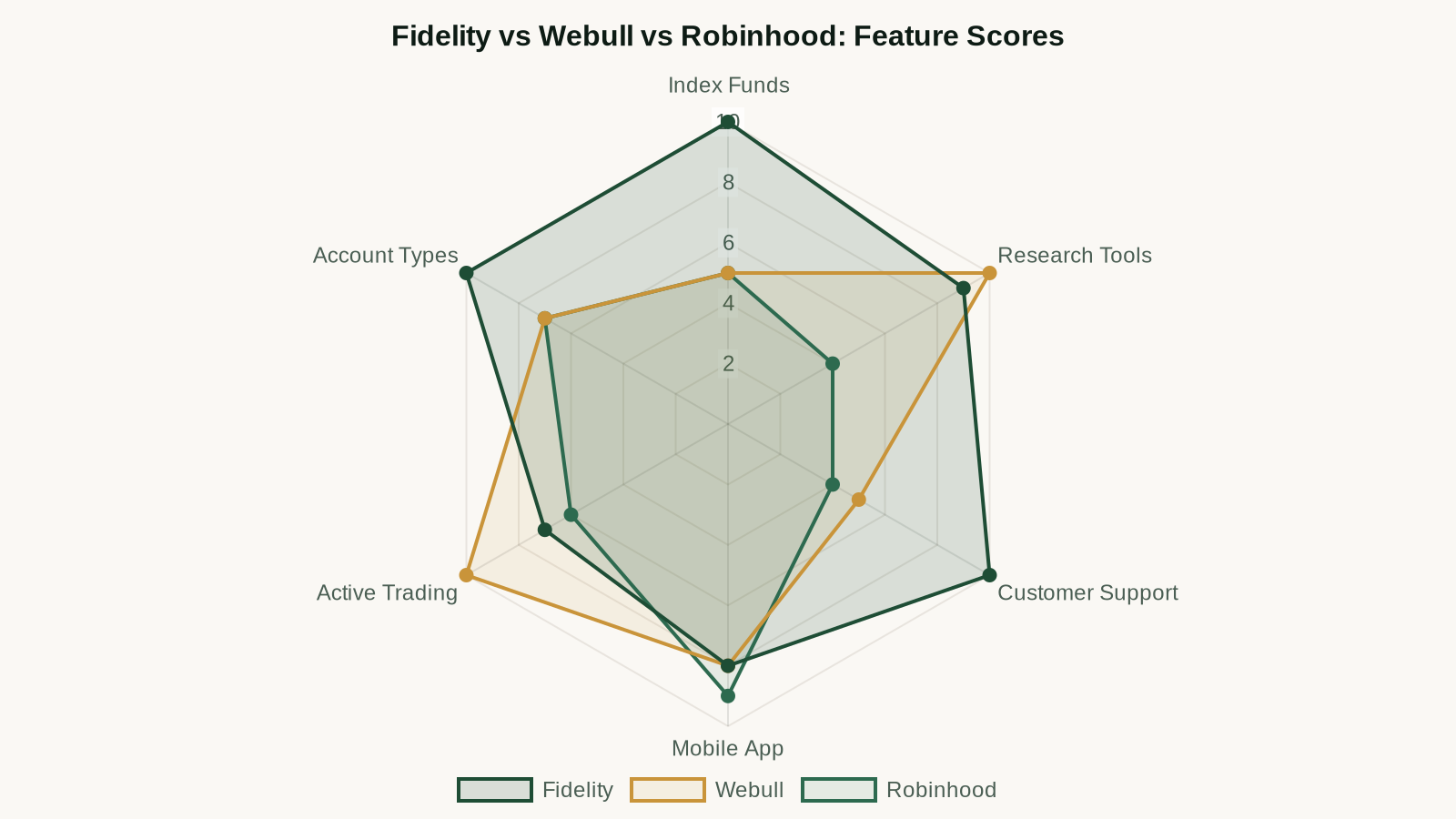
Fidelity: Best for Long-Term Investors and Beginners
Fidelity is the best choice for the vast majority of investors, and it's not particularly close. Here's why:
Zero-Cost Index Funds
Fidelity's FZROX and FZILX have 0.00% expense ratios — literally free. On $100,000 invested for 30 years at 7% average return, that saves approximately $75,000 compared to a fund with a 0.50% expense ratio. No other brokerage offers funds at 0% expense ratio.
Best Research and Education
Fidelity's research tools are among the best in the industry — professional-grade screeners, reports from multiple research firms, and extensive educational content. Unlike Webull's tools (which target active traders), Fidelity's research is accessible to investors of all levels.
Actual Customer Support
Fidelity offers 24/7 phone support — a real person, not a chatbot. When something goes wrong with your account (and occasionally things do), this matters. Robinhood and Webull have historically struggled with customer service quality.
Full Banking Ecosystem
Fidelity offers a checking account (with ATM fee reimbursements), a high-yield cash management account, and credit cards — the full banking stack at one institution. For people who want everything in one place, this is unmatched.
Best for: Long-term index fund investors, retirement account holders, beginners who want the best foundation.
Webull: Best for Active Traders and Technical Analysis
If you're actively trading stocks or options and care about charting tools, Webull is a serious platform. Its advanced charting rivals what you'd find on platforms charging $30–$50/month. Paper trading (simulated trading with fake money) lets you practice strategies without risk.
Where Webull Wins
- Charting: 50+ technical indicators, multiple chart types, real-time data. Best free charting tools of any retail broker.
- Extended hours trading: Pre-market (4 AM–9:30 AM ET) and after-hours (4 PM–8 PM ET) trading with real-time data during those sessions.
- Direct crypto trading: Webull supports direct crypto purchases (Bitcoin, Ethereum, and others) in addition to crypto ETFs.
- Paper trading: Practice account with $1,000,000 simulated dollars to test strategies.
Where Webull Falls Short
- No proprietary zero-cost index funds — for long-term ETF investing, you'll use the same Vanguard/iShares ETFs you'd find at any broker, paying 0.03–0.10% in expense ratios that Fidelity's FZROX/FZILX waive entirely
- Payment-for-order-flow execution quality is still a real caveat — independent 2026 routing reviews show web-to-close price improvement lags Fidelity and Schwab on large-cap market orders, which compounds for frequent traders
- Options trading requires level-2 or higher approval before you can trade multi-leg spreads, with level-3 taking days of account history — beginners expecting a Robinhood-style "tap to trade" experience are often surprised
- No full banking stack — no checking account, no bill pay, no debit card. Robinhood at least ships a debit card; Webull still leaves you with a brokerage silo
- No IRA contribution match, unlike Robinhood Gold — so you cannot plug an account-level percentage match into your retirement funding math
- Customer support is email- and chat-heavy with slower response times than Fidelity's 24/7 phone line, and the mobile app still draws complaints about crashes during high-volume sessions
Best for: Active traders, technical analysts, people who actively manage their portfolio and need sophisticated charting tools.
Robinhood: Best for Simplicity (With Caveats)

Robinhood pioneered commission-free trading and deserves credit for democratizing investing. The interface is genuinely the simplest of the three — clean, minimal, good for someone making their very first investment. But simplicity comes at a cost.
Where Robinhood Has Improved
- Robinhood Gold ($5/month) now offers 5% APY on uninvested cash — a legitimate feature
- IRAs now available with a 1% contribution match for Gold subscribers
- Customer service has meaningfully improved from its earlier customer-service low point
- Fractional shares work well for small investors
Robinhood's Ongoing Limitations
- No access to mutual funds — only stocks, ETFs, and crypto
- Revenue model includes payment for order flow, which may result in slightly worse execution prices (though the difference is minor for long-term investors)
- Research tools are still basic compared to Fidelity or Webull
- The interface's "gamification" design has been criticized for encouraging overtrading
- The GameStop-era trading halt during the meme-stock volatility period damaged trust significantly — and remains a touchstone for retail investors, even though the underlying platform has improved
Best for: Investors who value extreme simplicity and are making small, infrequent trades. Not recommended as your primary long-term investment account.
The Verdict: Which Should You Use?
- If you're building long-term wealth through index funds: Fidelity. No contest. The zero-cost funds alone are worth more than anything the other two offer over a 30-year investing horizon.
- If you're actively trading and need professional charting tools: Webull. The advanced tools at zero cost are the best available outside of institutional platforms.
- If you want the simplest possible entry point: Fidelity still wins — their interface has improved significantly and the zero-cost funds are too valuable to give up for a slightly cleaner design. Robinhood is a fallback for extreme simplicity.
You can also use both: Fidelity as your primary long-term account (Roth IRA, index funds) and Webull for active trading with a smaller allocation. There's no rule against having accounts at multiple brokers.
A Note on Account Security
All three are SIPC-insured up to $500,000 (including $250,000 in cash). This protects against brokerage failure, not investment losses. Enable two-factor authentication on all your brokerage accounts — investment accounts are high-value targets for fraud.
How we evaluated these platforms: Our scoring covers fees, features, security, support, and user experience on a single rubric — applied identically to every comparison we publish, regardless of affiliate relationships. Full methodology and conflict-of-interest disclosures are on our How We Review page.
Frequently Asked Questions
Can I transfer my account from Robinhood or Webull to Fidelity?
Yes. Use an ACATS transfer — this moves your holdings in-kind (without selling them) to the new broker. Fidelity will handle the transfer process once you open an account. Most transfers complete in 5–7 business days. Some brokers charge a $75 outgoing transfer fee.
Is my money safe at these brokers?
Your investments are protected by SIPC insurance against brokerage failure (not market losses). Cash in your account is held separately from the broker's operating funds. All three are registered broker-dealers with FINRA oversight. Your bigger risk is not market losses, not brokerage failure.
Which broker is best for a Roth IRA?
Fidelity, decisively. Access to zero-cost index funds (FZROX at 0.00% expense ratio) inside a tax-free Roth IRA is the most optimized long-term retirement account structure available to retail investors. Webull and Robinhood both offer IRAs, but without proprietary zero-cost funds, you're using the same ETFs you'd find at any broker.
Do I need to choose just one broker?
No. Many experienced investors use Fidelity for their long-term retirement accounts and a second broker for active trading or specific features. The only practical consideration is keeping track of tax reporting (each broker sends a separate 1099) and not spreading yourself so thin that you lose track of positions.
10 Income Streams Blueprint
Build 10 distinct income streams with AI doing the heavy lifting. 42-page system, 30-day plan, done-for-you tracker.
$97 one-time
Keep Reading



Get the Free Wealth Starter Kit
The step-by-step guide to your first $100K. Account setup, investment priorities, and a 12-month action plan.